I was looking back at an article I wrote in March 2016 foreshadowing the Brexit Referendum. Some other people remarked at its accuracy in terms of what we actually got from Brexit, so I feel no great need to rewrite the piece or even to write something new on the 10th anniversary of the Brexit referendum. Find the article at Shall I Stay or Shall I Go.
“Extraordinarily well worded”. Steve Rouse, Leader of Swindon for Europe.
“Still relevant – seems like the more things change, the more they stay the same… 😖” GregNewman, Northern Ireland.
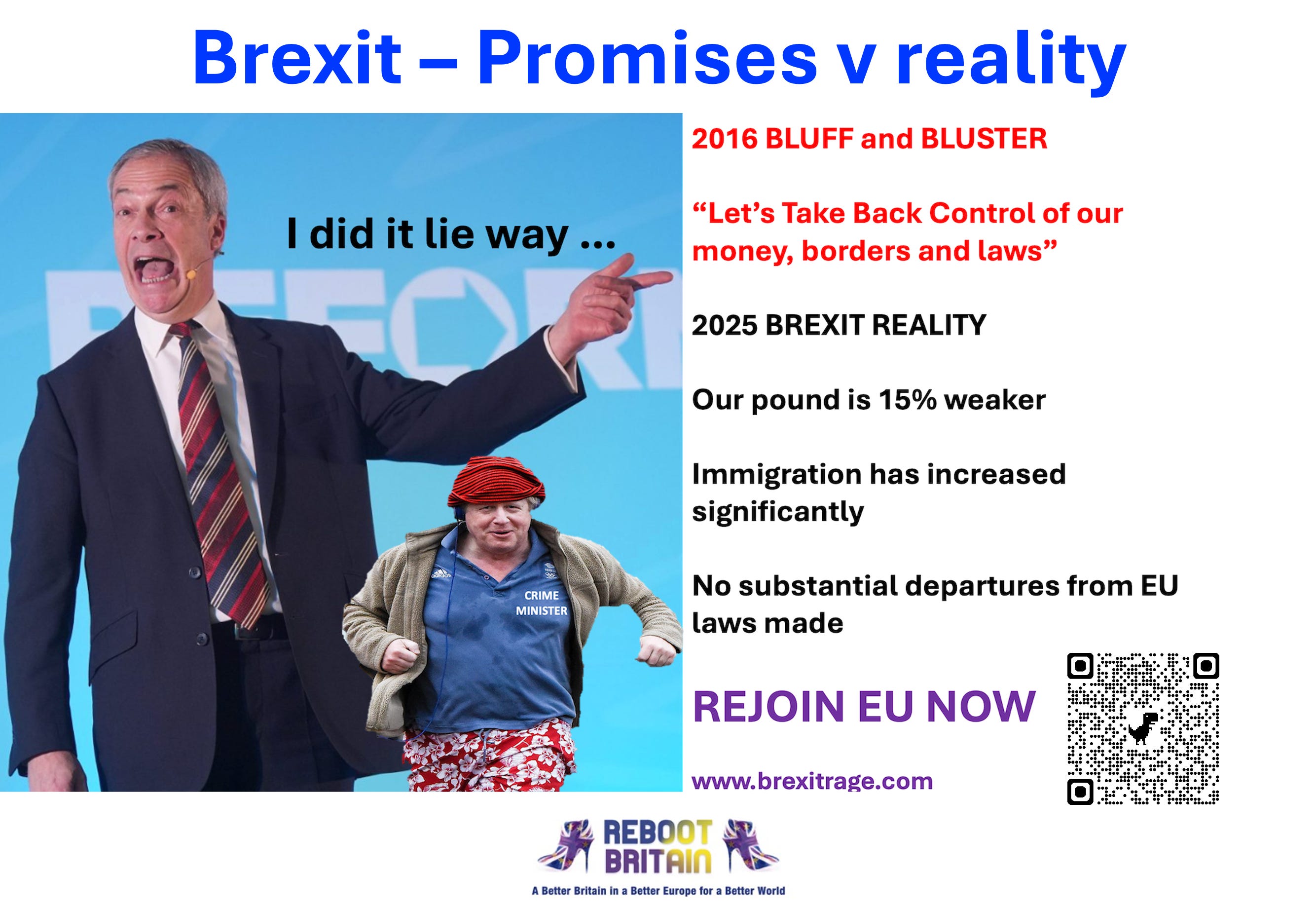
The three Brexit promises of taking back control of our money, borders and laws have been shown to be utter lies … Matthew Eliott (Vote Leave) appeared on Channel 4 News with some word salad about the fact that Brexit did deliver, except he could not explain how.
If you don’t have much time to dig deep, here’s a summary of the Brexit promises versus reality.
Hard Brexit Labour
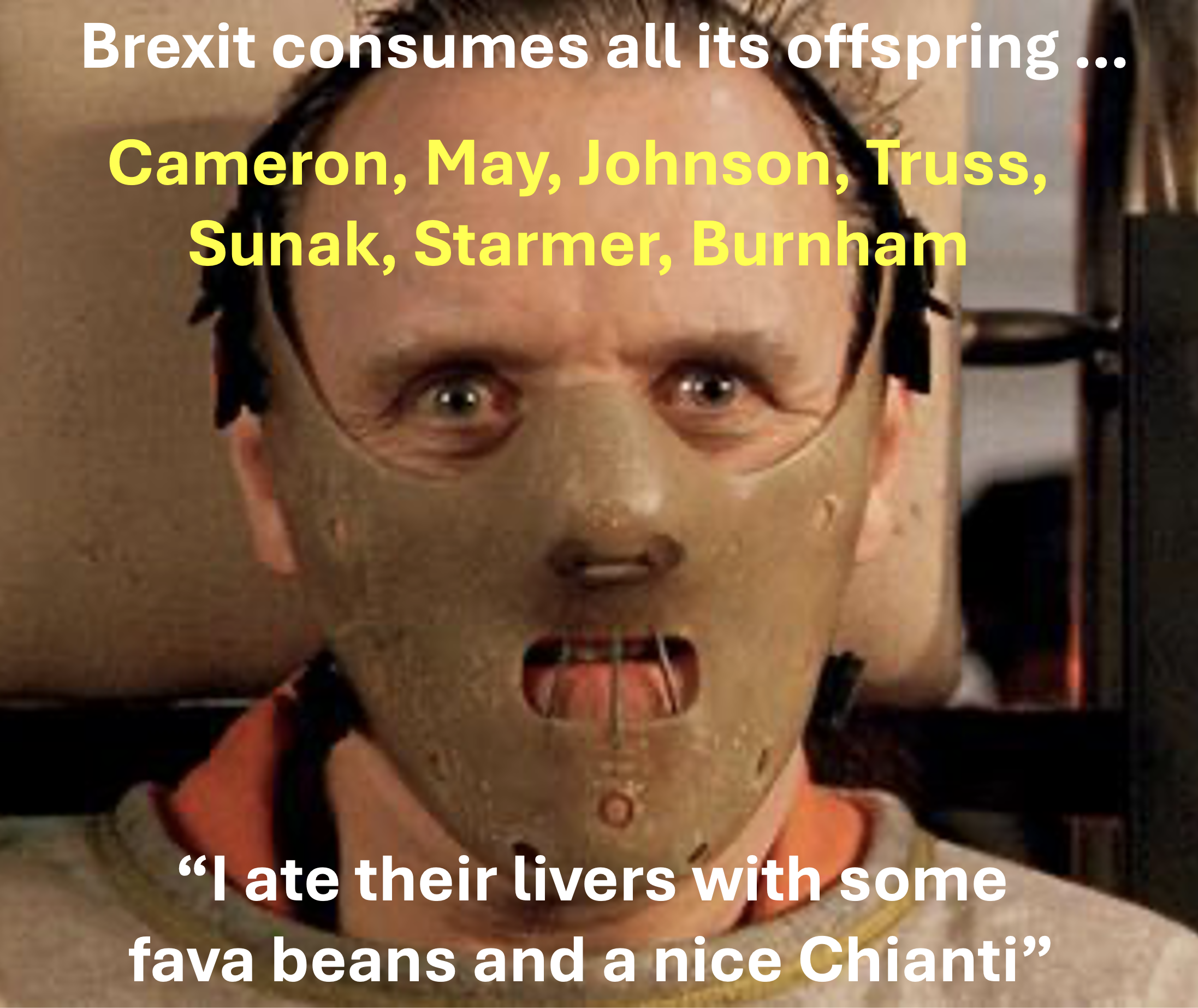
Andy Burnham has already nailed himself to the mast of Brexit by stating that Labour’s red lines must remain and that he will not relitigate Brexit, despite being wildly out of synch with the ‘will of the people’. I fear that he too will be consumed by Brexit and have made a new Hannibal Lecter t-shirt to predict his downfall. Mail me reboot@brexitrage.com to get yours.
But, compared with Starmer, Burnham is more pliable / chameleon like. He could turn once he gets to grips with the hard facts of Brexit as Prime Minister. Especially if he gives Wes Streeting a top job. We’ll have to see.
The Wasted Years
I’ll be updating the book we wrote soon, with new contributions from former MEP Michael Hindley, Dr Charlie Clutterbuck and others. Working title is “Brexit – The Wasted Years’
This is going to be a very long post so strap yourself in for the ride … We held A Great Debate with a Leave voter who still thought that Brexit is a good idea this week. The video of the debate uncut can be found below. In this piece I reflect on the points made. I am most grateful to Bob who ensured a cordial dialogue. I was pleased to see that he brought a range of colleagues, some of whom agreed with his views on Brexit. This made for a balanced debate.
The case for carrying on with Brexit
Bob is a finance consultant, and it turned out that many of his points for carrying on with Brexit were based on his personal dislike of the Euro and the belief that this experiment in monetary union had been a failure. As secondary factors, he believes that the EU executive is anti-democratic and that the referendum was very clear in its call to leave the European Union in totality, i.e. for Britain to become an isolated nation free to trade with any country that wishes to do so. Here are some points made by those who attended.
Brexit outcomes and Rejoin opportunities
This slide summarises the “headline promises” of Nigel and Boris versus the outcomes from Brexit. It’s not a pretty story. Excuses such as “We got the wrong Brexit”, “Brexit was thwarted”, “Remoaners were just too good at defeating Brexit” are just excuses. Whilst people did not know what to expect from Brexit in 2016, we do now and it’s a veritable shitshow of lies.
NF Promises v Reality.
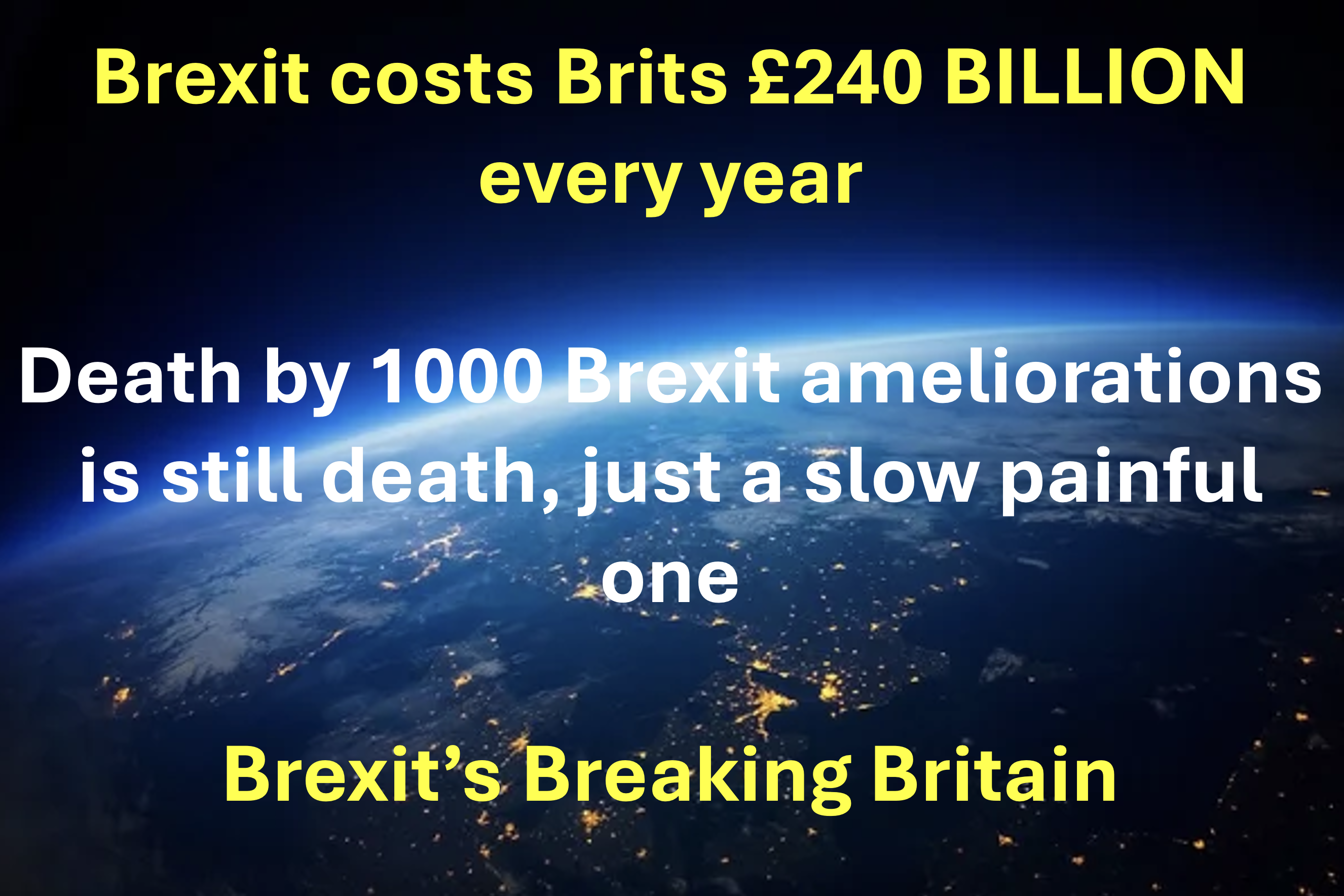
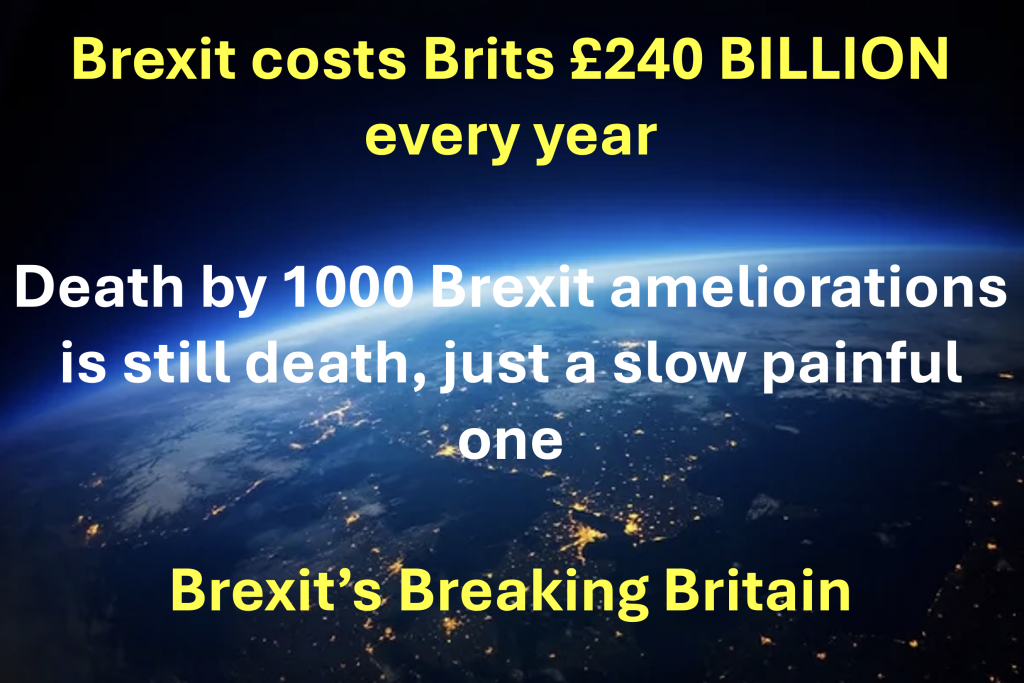
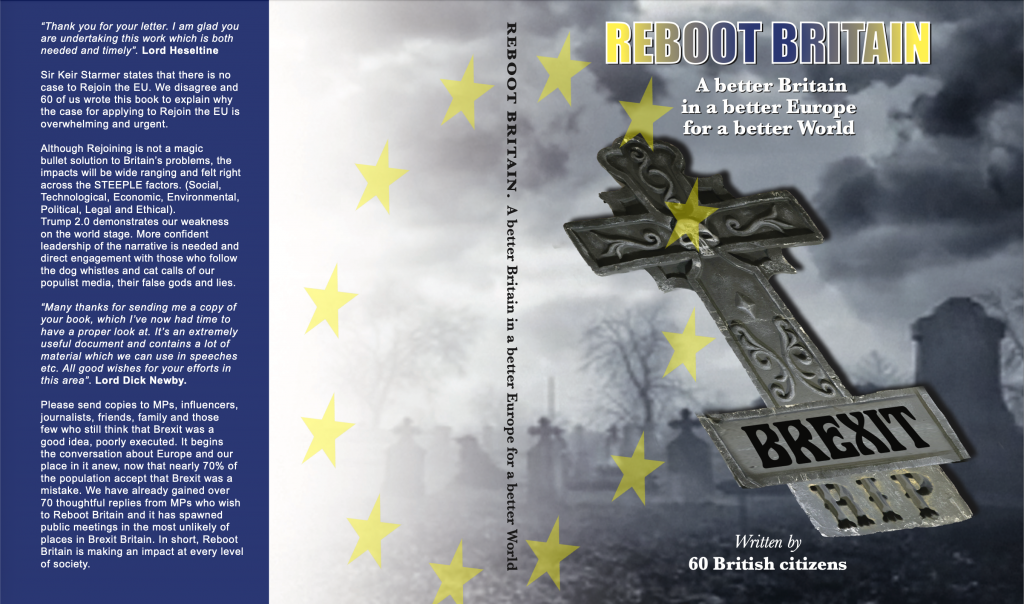
On the question of opportunities afforded by Rejoining the EU, read our comprehensive appraisal of this at Brexit RIP : Reboot Britain. The book is an excellent tool of influence. Send copies to MPs, Remainers who need some motivation and Leave voters in remorse. The majority of the leave narrative is about economics, yet Brexit impacts and opportunities cover the full spectrum of STEEPLE factorsand not just the £240 BILLION we are losing by carrying on with Brexit EVERY year. If you object to buying stuff on Amazon, you may order it via Waterstones etc. or buy direct by sending an e-mail to reboot@brexitrage.com stating how many copies you would like.
Not exactly a Great Debate – Just apply to Rejoin!!
On democracy and sovereignty
Charles Radley pointed out that the EU commission can be fired by the EU parliament which is a directly elected body to counter the assertion that the EU is an unelected bureacracy. Peter raised the Organisation Development issue (OD) that all large enterprises have faults. The EU is no different than a large enterprise in so far as it runs a meritocracy, with senior figures elected based on their capabilities. One can argue about the merits of a meritocracy versus direct election by the people. Notable problems with the latter approach include the election of Boris Johnson by the people, who showed himself to have little flair for leadership of the country and Nigel Farage by the people of Clacton who has singularly failed to serve his constituents whilst trousering foreign donations for “security” whilst whipping up hatred in Britain.
There was a discussion about sovereignty. Gina Miller’s case against the Government demonstrated that Britain did not lose sovereignty as a result of being in the EU. We were still able to have Cornish Pasties, drink pints, drive on the LHS of the road etc. No answers were provided to the question as to what we are now able to do after Brexit that we weren’t when we were in the EU. See more at Brexit Freedoms.
Greg asked some important questions on sovereignty: How come the UK government was able, as a body, to enact Brexit if they had no self-sovereignty in the EU? The notion of self-sovereignty is an interesting argument – as for those who would never condone leaving the EU, they had sacrificed their sovereignty as they would not use the only control they had left. For leave voters, as they were willing to pull the trigger and leave, they had not lost sovereignty. Laurence pointed out that few really understand the issue of sovereignty and Phil Emsley explained that all member states can pass their own laws.
It’s not just the economics, dammit
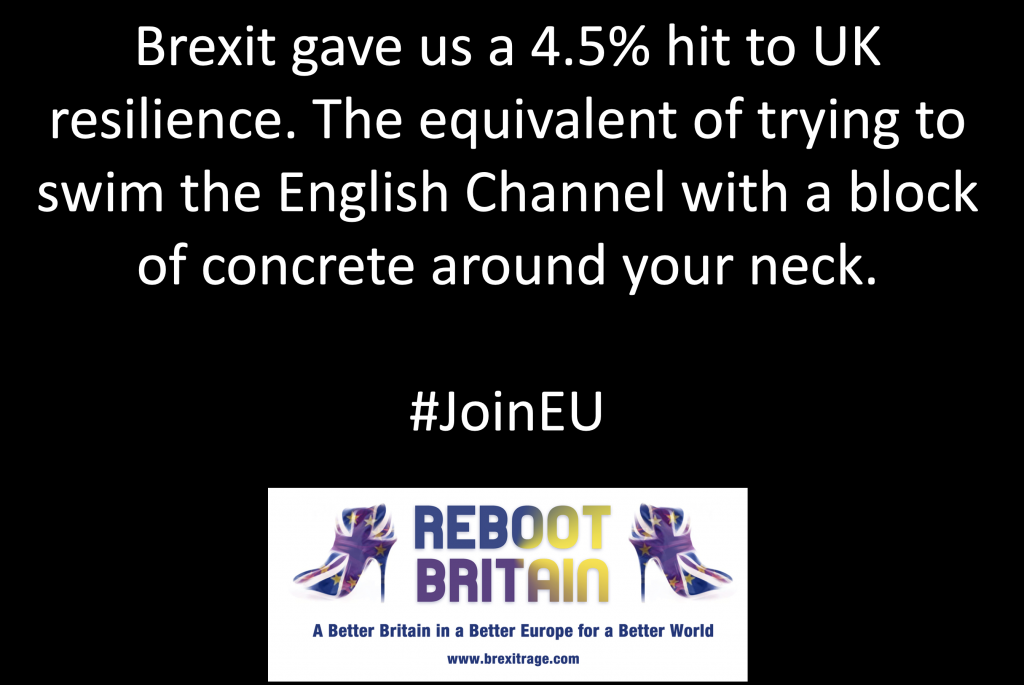
There was an interesting debate about the economic impact. It matters not whether it’s the 4.5% figure or the 6-8% figure, the impact dwarfs most things in Britain. For comparison, it took just 3% GDP loss to plunge the world into recession in 2008. £240 BILLION lost every year is an eye watering number.
Recently updated to 6-8%
Alan Meekings asked the question of Bob: Are you seeking to avoid, or perhaps ignore, the headline adverse economic impacts of Brexit, as identified by Nick Bloom and his co-authors at Stanford, namely:
(1) UK GDP: about 6% to 8% lower by 2025 than it would have been without Brexit. (2) Business investment: about 12% to 18% lower. (3) Employment: about 3% to 4% lower. (4) Productivity: about 3% to 4% lower.
Bob also wished to add some clarifications on the ECB: The main transmission mechanism for monetary policies aimed at ensuring price stability is the interest rates paid on the accounts held by commercial/private banks in the books of the member state national central bank that sponsors them into the Eurosystem (the ECB only runs accounts for the member state national central banks, not for commercial/private banks). The ECB eliminated this transmission mechanism when it stopped paying interest on those accounts, with the aim of precluding that losses on the ECB’s equivalent of QE might be passed up the line from the member state national central bank to the ECB, triggering a requirement for the ECB to be recapitalised. The situation is alluded to in this blog, which explains why the Bank of England should not do the same.
Phil Emsley responded: What the ECB do is down to them and you accept it or get out. The EU needs to be reformed and if remain and reform was on the ballot it would have won by a landslide.
Project Fear
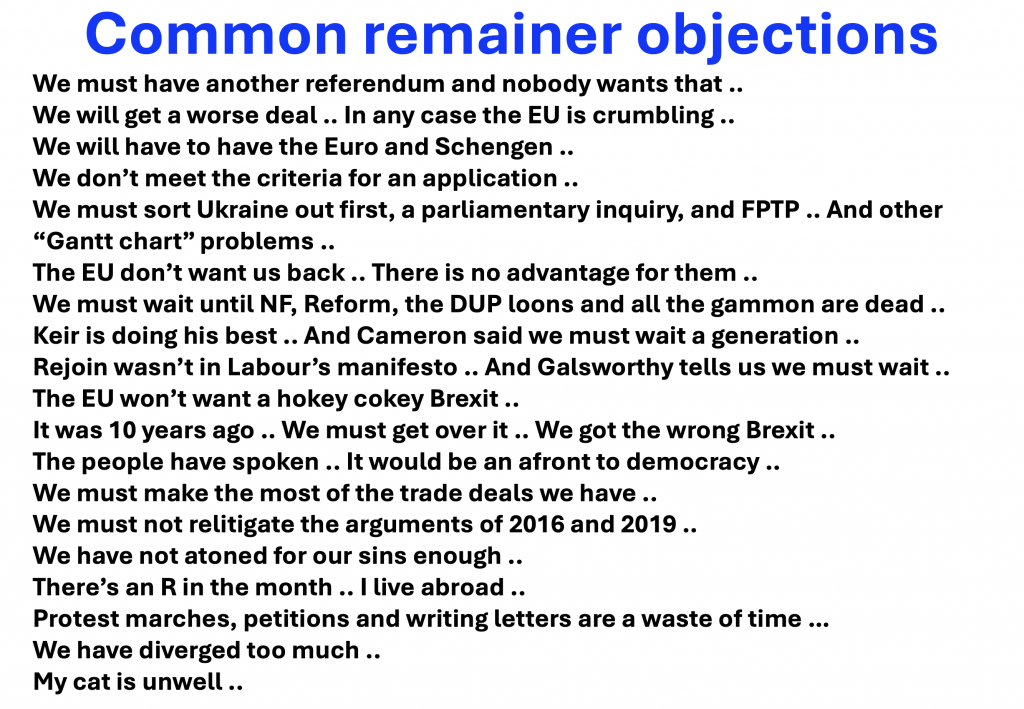
The usual arguments about Rejoining came up : “They don’t want us back”. “We’ll have to have the Euro” and so on. These are the Project Fear arguments to stop us applying. As Greg stated : All it needs is a letter from the leader, the PM, to say “We would like to join the EU, please”.
Reasons to Carry on with Brexit. Only the cat is valid ….
There was the strange contradiction that it appears that few remaining leave voters trust the EU, but they are willing to use the EUs rules to prevent UK from Rejoining. Steve W gave several examples: For example “Ireland and Northern Ireland rejoining would get EU acceptance”. This is incorrect.
Immigration
Monica del Pilar Uribe Marin from The Prisma Newspaper added “Immigration is indeed a very important issue in the whole Brexit debate”. The immigration issue is yet another issue which Nigel Farage has managed to force into the Overton Window when solutions to this matter are available and some are gradually being implemented. Here is our algorithm from 2023 which outlines the needed process. Before Brexit only 7% of British people cared about migration. This is a classic example of a manufactured issue by NF.
It’s easy to throw stones from the sidelines and I note that Nigel no longer wants to talk about Brexit now that it has been shown to be a failure. Cue “Pure Cold Rage”, his next manufactured issue to keep people angry.
POLICE COME UNDER ATTACK IN SOUTHAMPTON BY ANGRY PROTESTORS
Thank you to Bob and all who attended. I next look forward to a debate with Steve Horton, Head of Logical Politics, who chickened out when he was invited. Logical P aim to unite the Far Right including affiliations to the EDL and BNP (now removed from their website, oh dear).
Postscript
One of the event attendees (Steven Wright, PRINCE II practitioner, not the dead Radio 2 presenter) is under the impression that I edited the video and transcript of the session. He claims that I wrongly attributed him to one of the online chat comments as well. For clarity I have attached the online chat. He made so many comments online that it was hard to work out who said what, but for clarity it is linked below.