

Here is our paper on “Rejoin EU – Why Delay is Dangerous”. Please sign our petition where you are able to download your copy for free.
Then mail your MP and other influencers. Ideally print a copy and pop in an envelope with a personal note. We know that printed letters are given more weight than e-mails. If you need a short letter to add, we have offered you one on the petition.
And / or you can also e-mail the paper. Your MP’s e-mail has the format of firstname.lastname.mp@parliament.uk so, for example, Andy Burnham is andy.burnham.mp@parliament.uk The full text of the paper follows and a QR code for sharing.
Rejoin EU – Why delay is dangerous
Executive Summary
Andy Burnham’s announcement on Rejoining the EU is welcome after years of parliamentary paralysis on Brexit. Brexit is proven dead yet continues to kill Britain slowly across all metrics: economic, sociological, political, legal, ethical, technological and environmental. Most politicians agree that we must Reboot Britain, in part by applying to Rejoin the EU. However, we must begin now, and not in the mid 2030s. Delay is dangerous for four principal reasons, expanded in this paper:
- Business damage: The damage from Brexit will be complete, much of it irreversible.
- Moral Hazard: 7-10 years of continued uncertainty provides an extended opportunity for bad actors inside and outside Britain to infect our politics. Multiple scenarios are possible across the decade. One of the most potent is some kind of merger / acquisition between Restore and Reform or The Conservatives.
- Business and public confidence: Prolonged uncertainty will be catastrophic for UK business confidence and inward investment. Whilst nobody liked the debates during the 2016 referendum, there is zero appetite for a decade of debate about Rejoin.
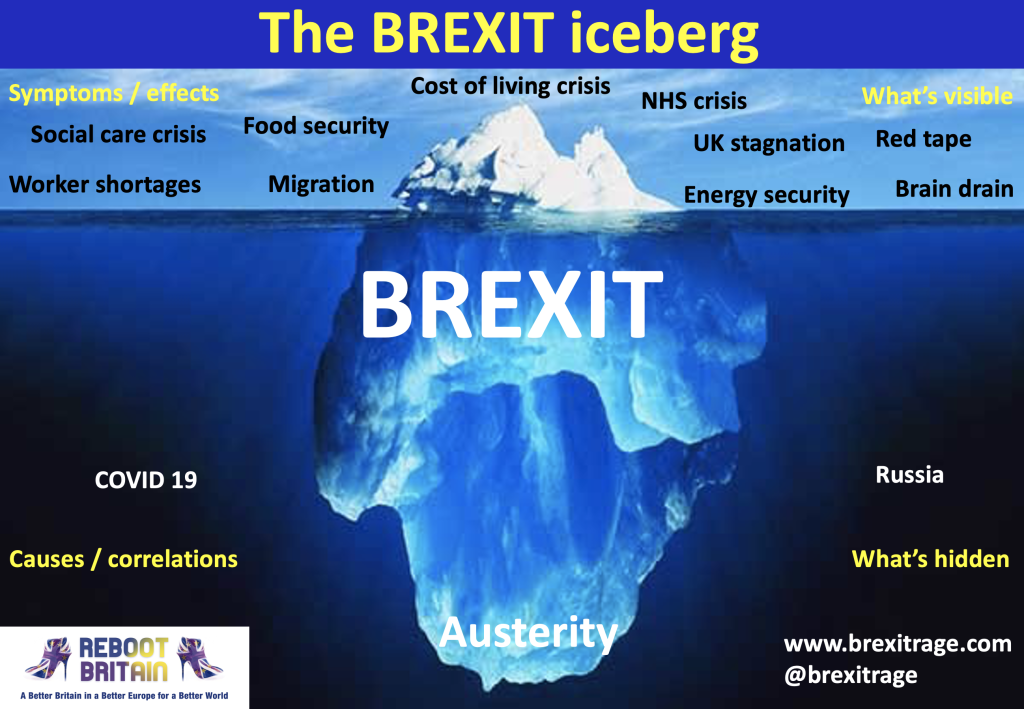
- Overton Windows cleaned: Public interest and pressure has been attenuated by parliamentary silence on Brexit and the fact that there is no coherent movement to Rejoin the EU. Instead, the Overton window has been shifted onto the ‘offspring of Brexit’ e.g. cost of living, NHS, social care, migration and parochial / identity political issues. All these issues have at least some roots in Brexit.
We must prepare Britain for change via a series of national conversations about ‘A Better Britain in a Better Europe for a Better World’. We began these in 2025, and all the data is publicly available to support an application to Rejoin. Action can come from a majority decision in Parliament, a General Election promise or a referendum. Even senior observers on all sides point out that ‘logical incrementalism’ on Brexit, in other words, more small slow steps, will not deliver the needed growth in Britain.
Most British people now accept that Brexit has broken Britain across all the STEEPLE factors. Externally, we live in a perilous world in terms of global conflicts, security, unfettered and unregulated AI, the march of populism and ‘strong man’ leaders. All of these add weight to the argument that we should align with our partners in Europe now.
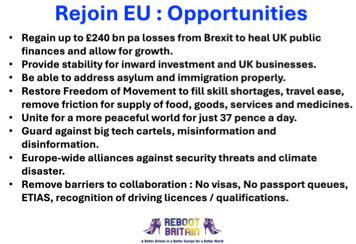
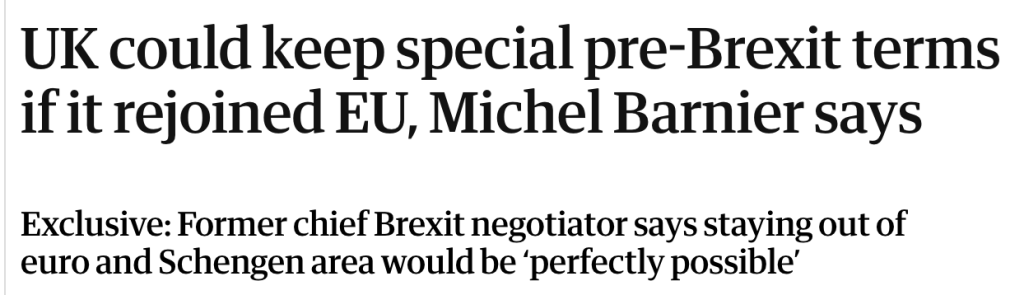
European leaders have stated that the door is open, we could return quickly and on similar or the same terms. Caution never delivered growth. Perilous times need reliable allies. So, we must lead, not lag. Brexit costs UK between 4.5 and 8% of GDP or up to £240 billion every year, or a much-needed uplift to defence, a national care service, etc.
Delay is dangerous
The risks in delaying an approach to Rejoin EU via an Article 49 letter to the 2030s are:
- Recovering Britain’s resilience
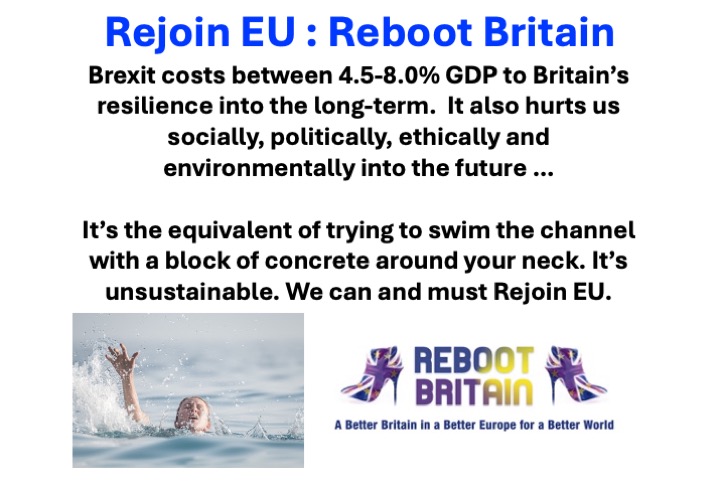
Brexit costs Britain and its citizens between 4.5 and 8% or up to £240 BILLIONevery year. This is in line with Government predictions made before people voted for Brexit, which ranged from about 3% to an eye-watering 12% for a no deal Brexit. For comparison, it took just a 3% hit on GDP to crash UK’s economy in 2008. This itself led to a decade of austerity, which helped to swing the Brexit vote in 2016, alongside a series of false promises about zero downsides, only sunny uplands.
Whilst the business impacts have largely been incremental, they have been continuous. Whilst larger enterprises can and have pivoted towards different markets, many have decided either not to export, to move to European bases or simply to cease trading. Some of these decisions are one time moves. By the mid 2030s, business damage from Brexit will be complete, much of it irreversible. Having undone 40 years of integration, many if not most will be reluctant or unable to switch back again.
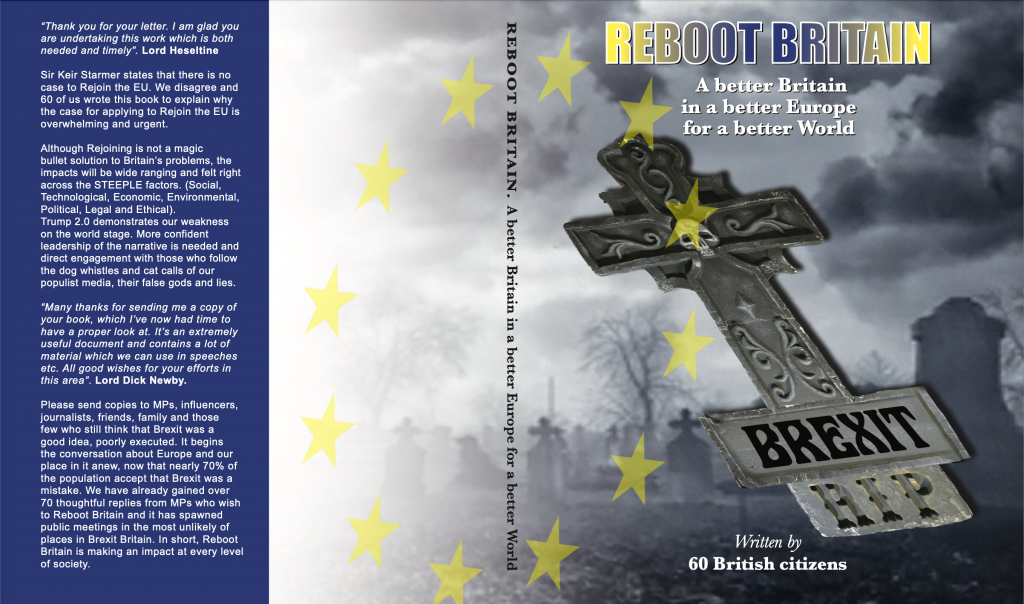
However, this is not just an economic argument. The book Reboot Britain outlines the impacts and opportunities right across the STEEPLE (Social, Technical, Economic, Environmental, Political, Legal and Ethical) factors. In terms of Britain’s resilience, Brexit is rather like trying to swim the English Channel with a 20 kg block of concrete around your neck.
- Moral Hazards from inside and afar
7-10 years of continued uncertainty provides an extended opportunity for bad actors within and outside Britain to get involved in our politics. Since Andy Burnham’s announcement, we have already noted an upsurge of disinformation from former Vote Leave figures and in the right-wing press. Multiple political scenarios are possible across that extended window.
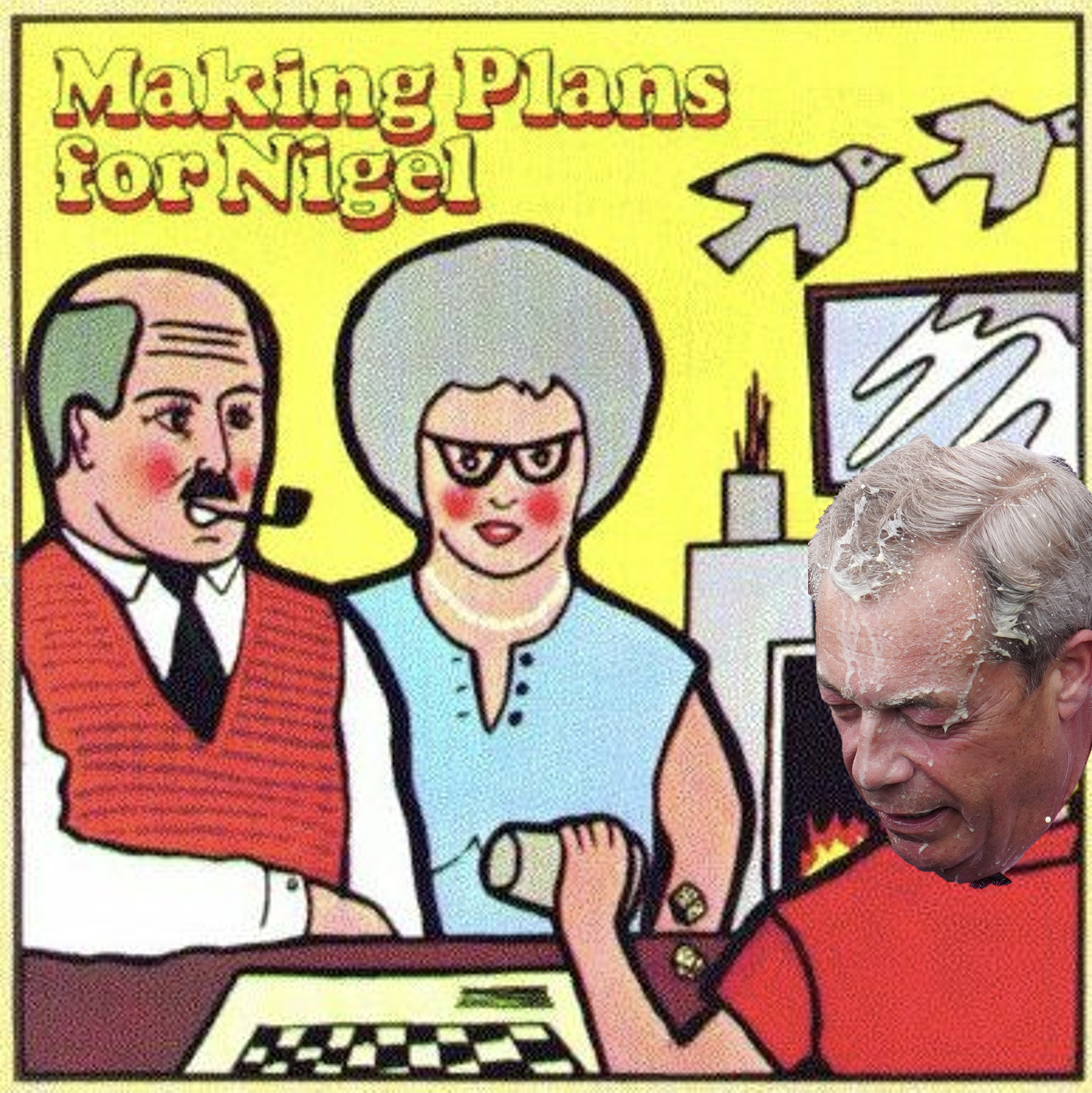
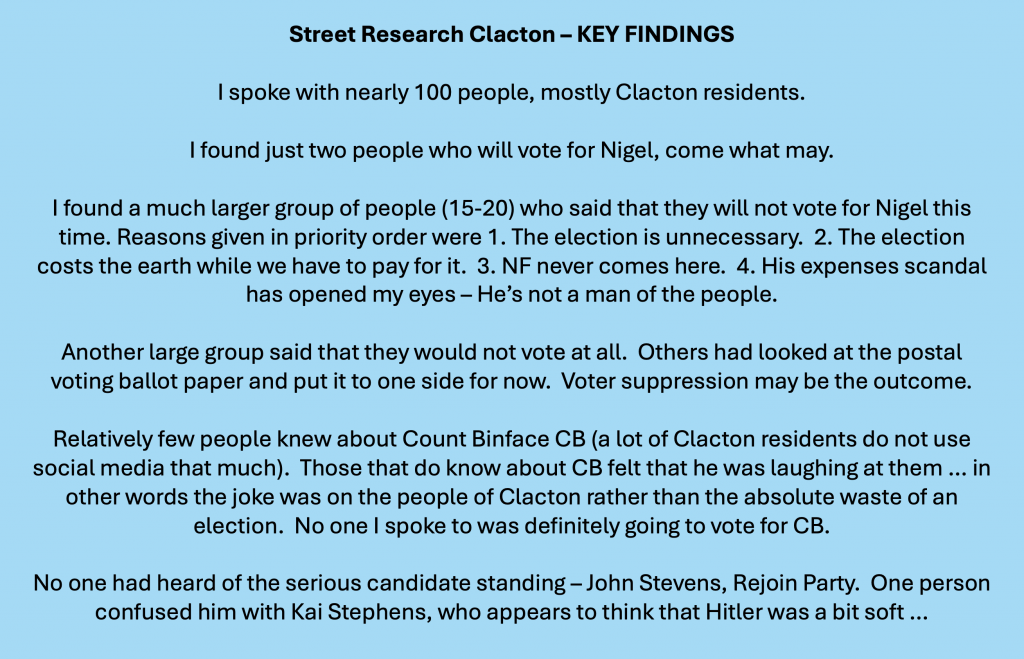
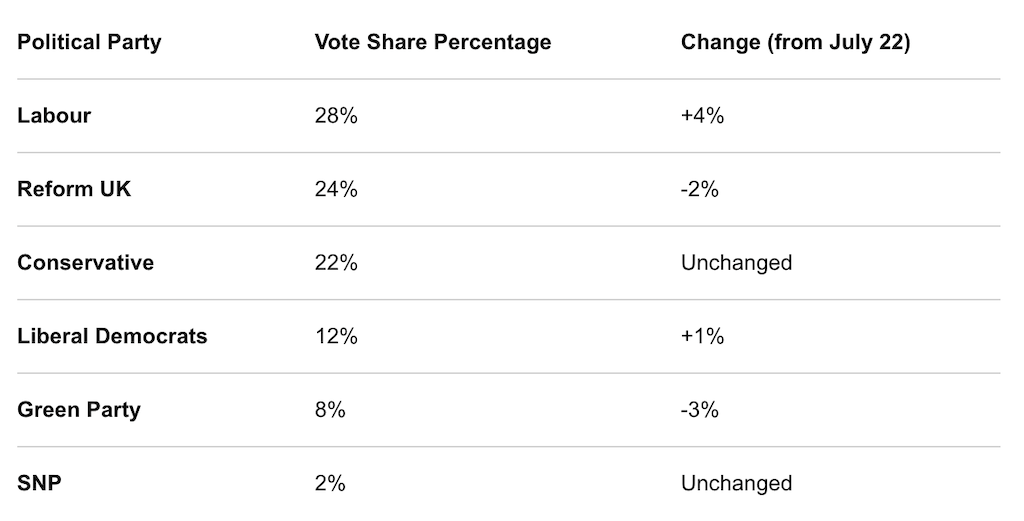
One of the most potent is some kind of merger / acquisition between Restore and Reform and / or The Conservatives. At this point, Nigel Farage is possibly the main obstacle to Rupert Lowe’s alignment with Reform UK. Farage is now a net vote loser for Reform UK. Pending changes within the Conservative party, other alliances of convenience are possible. This would be a hammer blow to a second Labour term and potentially any progressive alliances between Lib Dems, Greens etc.
Political fluidity, disruptive strategy and expediency may also affect Labour, the Lib Dems and Greens. In short, nothing can be ruled out across such a long period. As argued above, the time for action is now.
Over the next 7-10 years, The SNP, Sinn Fein and Plaid Cymru may also have taken steps along the road to independence. This is itself a further validation of Brexit’s destructive impact on The United Kingdom. We have ourselves witnessed the beginnings of the so-called Celtic alliance in the Houses of Parliament.
We know that Russia has in the past decade devoted considerable resources to disrupting the EU and the UK’s relationship to the Union. Every further year of hesitancy from the British government on the European question gives further opportunities for mischief-making to Vladimir Putin. And we know that he has potential sympathisers among the pro-Brexit wing of British politics.
- Business and public confidence
Prolonged uncertainty on Brexit over the next decade will be catastrophic for business confidence, staffing and inward investment. We already know that foreign direct investment (FDI) inflows dropped by 37 per cent between 2016 and 2022, as multinational companies relocated operations to the EU for single market access, and external investors diverted their cash elsewhere. In terms of employment, agriculture, healthcare and hospitality are amongst the sectors that have all encountered labour shortages, resulting in higher operating costs while restricting output. Fishing, another key industry which voted for Brexit, and which was weaponised by Nigel Farage in 2016, has lived to regret it.
Whilst nobody liked the debates that were thrown up by the 2016 referendum, there is zero appetite for another decade long mass debate about Brexit. We are already seeing a resurgence of “Project Fear”, but this time being run by Vote Leave acolytes and far right media outlets. This will become a new normal and thus the longer we delay the decision to apply to Rejoin, the more toxic the narrative will become.
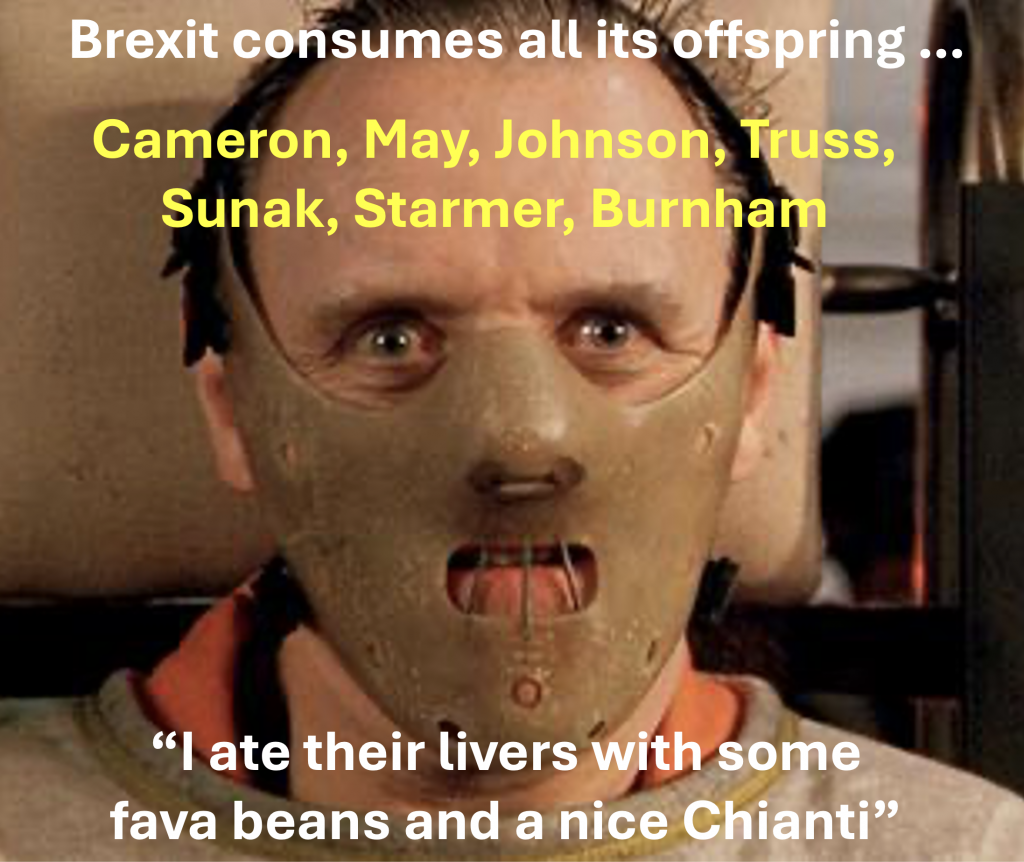
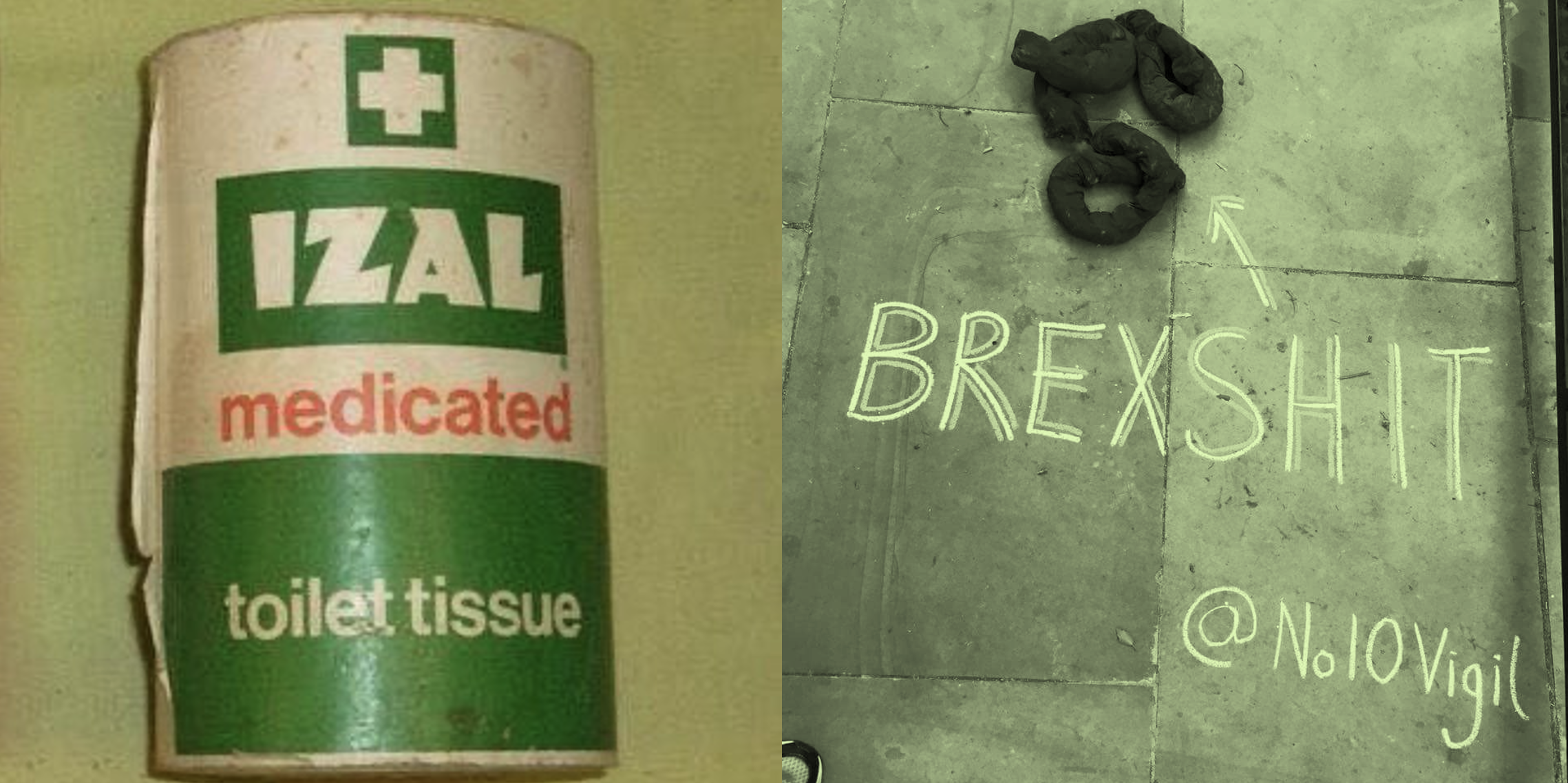
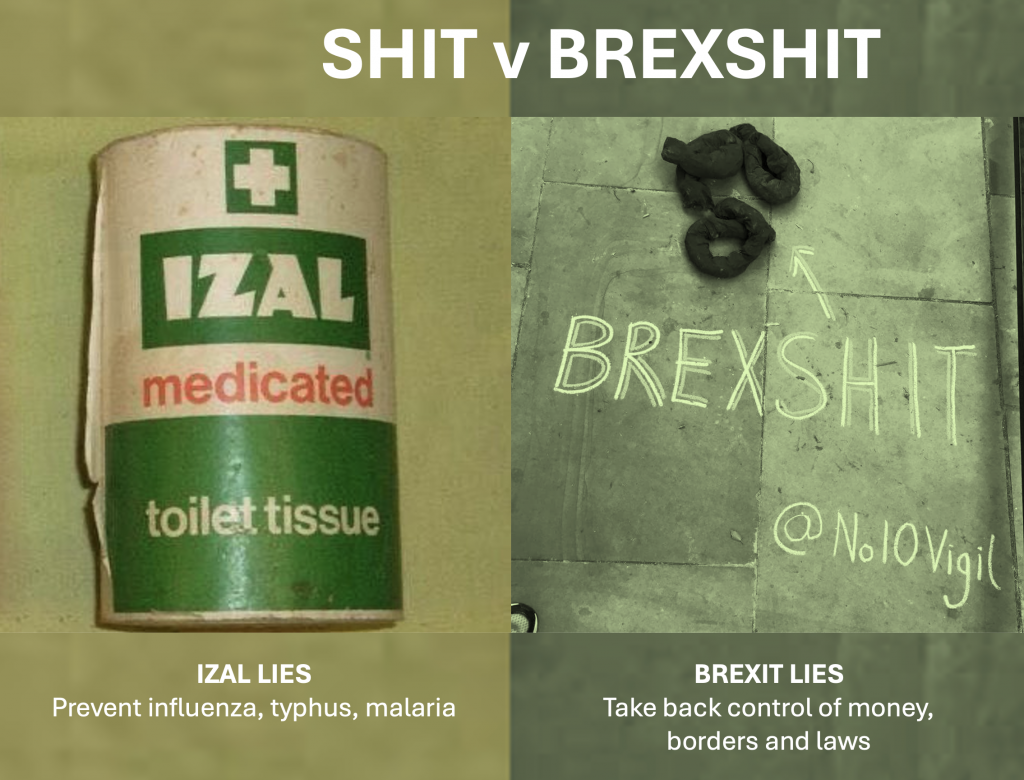
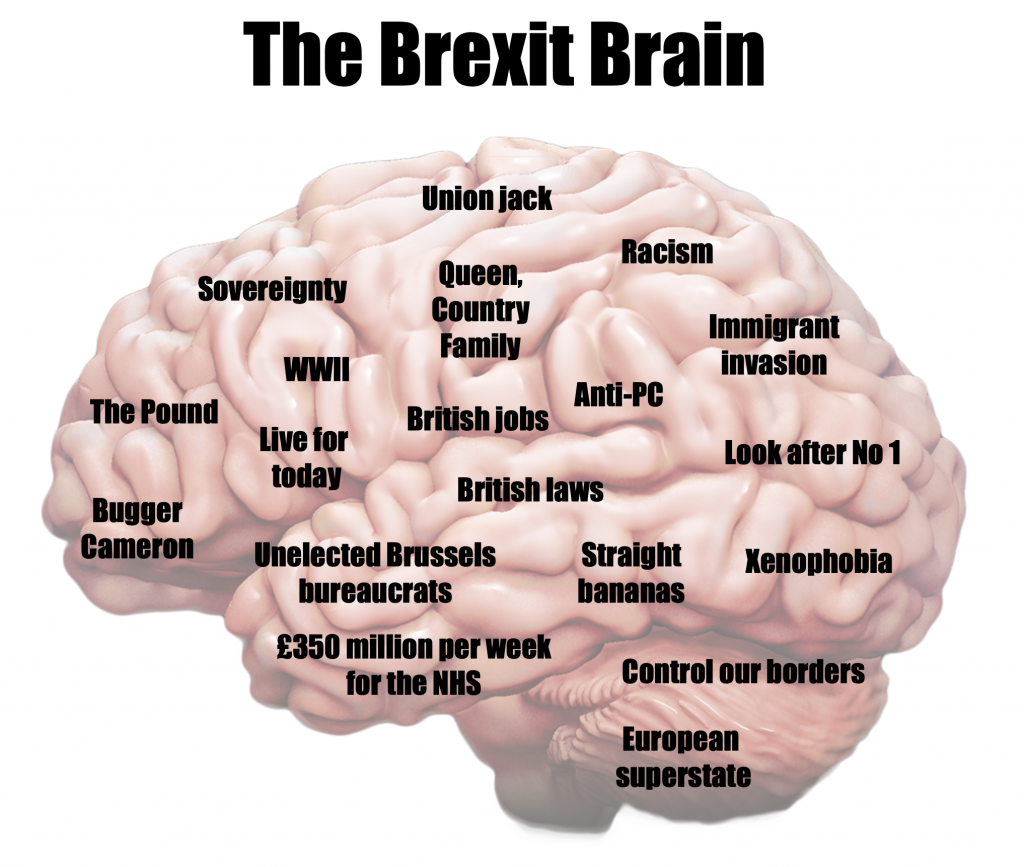
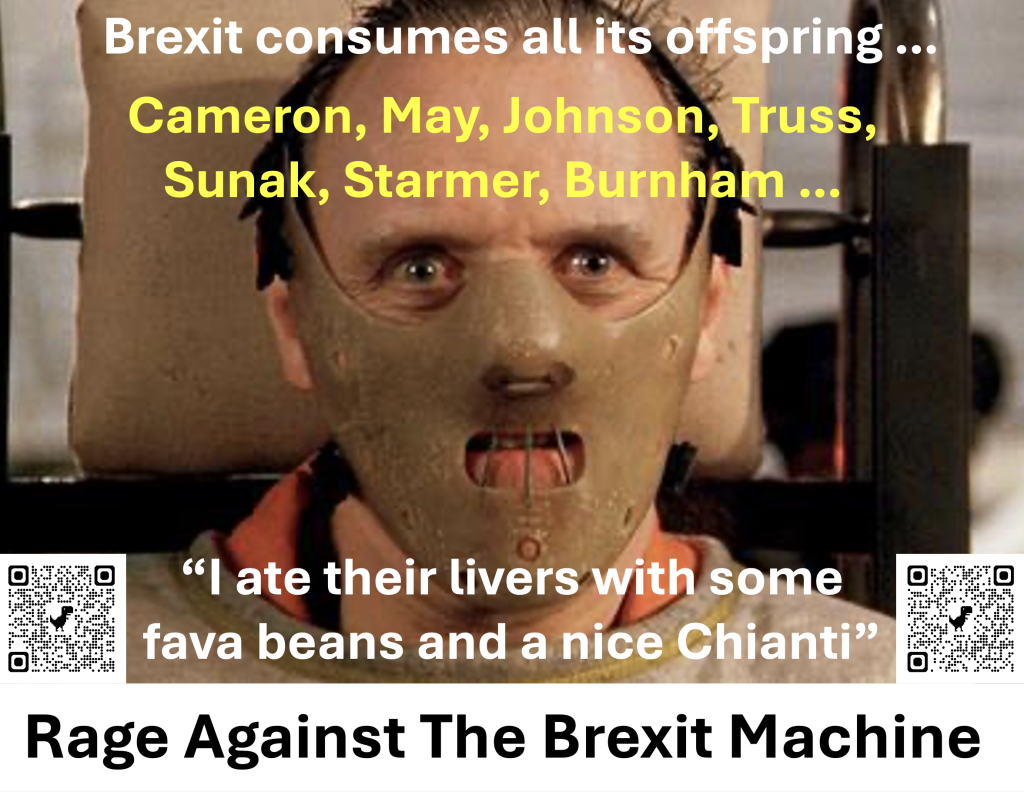
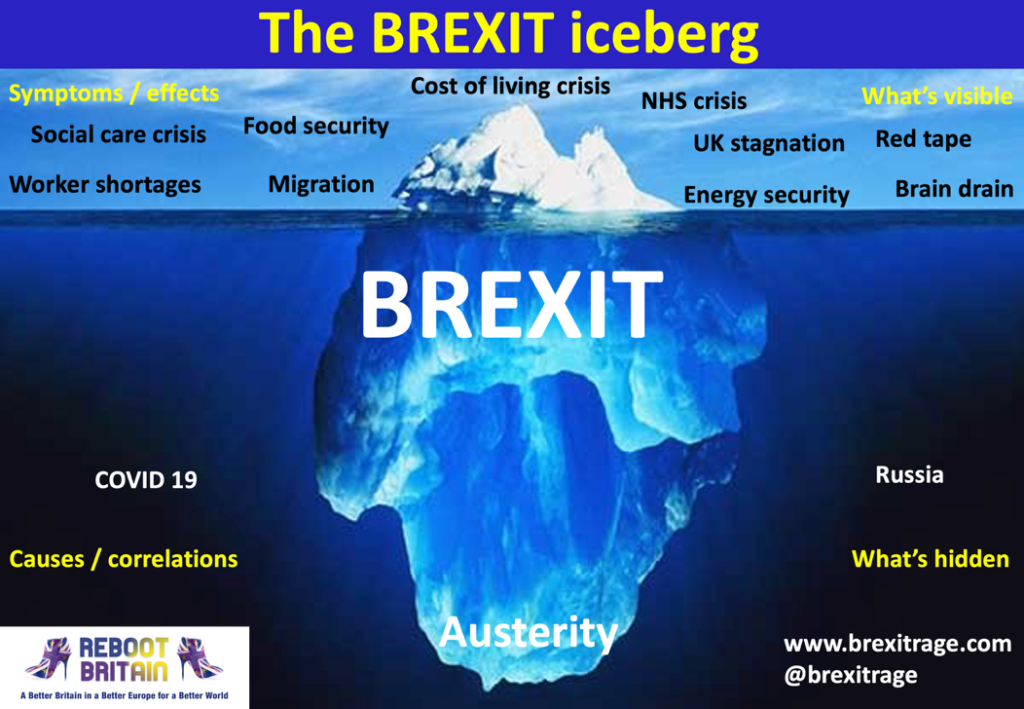
By opening the conversation now, Andy Burnham may well find that Brexit becomes a long-term malignant tumour in public discourse. Without surgical removal, it may claim further victims, having taken the heads of six Prime Ministers in ten years through its cancerous effects. Brexit has literally consumed all its offspring. It is a matter of time before it claims another scalp … This gruesome graphic sums up the grim reality.
- Overton windows cleaned
There is no appreciable or sizeable movement to Rejoin the EU in 2026, given the fragmentation of the various Rejoin movements (akin to Indonesia – 17 000 islands, many unoccupied and a few bigger ones who compete for the hearts, minds and bank balances of their followers}. There is no reason to suppose it would be any bigger or better by the mid 2030s.
There is also a complete lack of agreement amidst the various ‘islands’ on both ends (what is the destination?) and means of reaching the destination (the journey). We are dealing with what is often characterised as a wicked problem. If a series of national conversations are to be held on the topic of ‘A Better Britain in a Better Europe for a Better World’, it will need skilful leadership to achieve the required levels of convergence for a more United Kingdom. We have already offered such support on the Organisation Development (OD) disciplines and large-scale event design implications of this (Open Space Tech etc) to various MPs in this regard.
Public pressure on Brexit and Europe has also been attenuated by parliamentary silence on the matter, e.g. in the 2024 General Election. The Overton window has moved towards the ‘offspring’ of Brexit e.g. cost of living, NHS, social care, migration and parochial / identity political issues. All have their roots in Brexit, as this multiple cause and effect model shows. A properly designed national conversation would bring Brexit back into a controlled and civil dialogue about the issues that matter to people, politicians and politics.
Professor Sir John Curtice stated that public opinion had shifted despite a relative silence from many parties and “therefore, if you were to start to make the argument … you should be able to move the dial further”. He warned of the dangers of delay as the salience of Brexit declines in public consciousness. Once an Overton Window has been ‘cleansed’ it is very unlikely that the same issues will appear in it again … unless done in deliberate and controlled manner.
Summary
in summary, Britain has fared badly, post Brexit. Brexit has damaged our economy, split the UK and its component parts and reduced us to a minor player on the teetering edge of a significant political entity, this at a time of enormous socio-economic pressure from America, Russia and the Far East. It is estimated that we are losing 4.5-8% of our annual GDP. This looks set continue under the last two years of a Trump Presidency as it may turn to easier targets outside the USA, whilst the Democrats naturally focus on the domestic agenda.
The current British government has indicated a willingness to consider the issue of rejoining Europe in some form, but so far has not indicated any urgency in the matter. The lack of urgency is counter-productive, as further delay will only harden the damage already caused to our ability to create growth and put the UK back on track as a successful and prosperous country.
The UK Labour government currently has an enormous majority in Parliament and could take the necessary action of a unilateral nature. Inaction presents a clear and present danger to the UK and its standing in the world.
Recommendation
That this paper is submitted to all progressive MPs and political thinkers, emphasising the urgency of a move to rejoin Europe and the European Union.
We are available to assist with the formulation of a strategy and event designs to deliver a national conversation about a Better Britain in a Better Europe for a Better World across a period of 3-6 months, starting in 2017.
Peter Cook – Reboot Britain.
Greg Newman.
Colonel Terence Knott – President, Amicale Europe Pays de Fayence.
November 16th, 2026